• Welcome to ASR. There are many reviews of audio hardware and expert members to help answer your questions. Click here to have your audio equipment measured for free!

Adam T5V Review (Studio Monitor)

If I'm understanding correctly then this should do the job in a unixy terminal (so probably including Mac, WSL):
Bash:
awk '{print $1,$2}' CEA2034.txt > freq_on_axis.txt
 
These are great speakers. I’ve been using them for about a month now, and overall I’m very happy with them. However, there’s one important thing I want to mention: don’t bother using an EQ unless your room is acoustically well treated. It’s better to leave the frequency response alone.


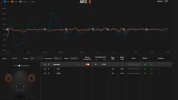
I bought an ARC Studio X to calibrate my room because it isn’t acoustically treated yet. The speakers are placed on wooden stands with foam isolation pads, more than 40 cm away from the wall, with the tweeters aimed directly at my ears, and positioned in the proper listening spot.


Even under these conditions, the measured frequency response in my room is very different from the measurements shown in this review. So if you buy these speakers, I highly recommend calibrating your room first and adding acoustic treatment. At a minimum, you should install 10 cm (4-inch) thick acoustic panels.


Without room calibration and proper acoustic treatment, you won’t achieve a flat frequency response. And if you use EQ presets created by other users, you’ll most likely make the sound worse, not better.
 

Attachments

  • IMG_3989.jpeg
    IMG_3989.jpeg
    61.6 KB · Views: 58
Without room calibration and proper acoustic treatment, you won’t achieve a flat frequency response. And if you use EQ presets created by other users, you’ll most likely make the sound worse, not better.
Actually, above the Schröder frequency of your room the opposite is true.

Here, correcting the frequency response based on your own measurements will likely make the sound worse, because you want to correct the direct frequency response whereas software like ARC X will correct the steady state response, often at the expense of direct response.

So above Schröder, you're actually better off using EQ presets created by other users based on the anechoic frequency response data of the loudspeaker, as those can correct only the direct sound.

Then let software like REW or ARC X measure the in-room frequency response (ideally using MMM), and correct only the frequency response below Schröder (⁓400Hz).

Finally, add those correction filters to the anechoic loudspeaker correction filters and you have the best of both worlds: correction of direct sound where it matters and correction of in-room response where it makes sense.
I think that’s true for single-point measurements. However, ARC X in Advanced mode uses 21 measurement positions around the listening area, not just one. It’s correcting the listening volume rather than a single point, so narrow position-specific peaks and nulls are much less likely to end up in the final correction. That’s why I think it’s a different case.
 
Actually, above the Schröder frequency of your room the opposite is true.

Here, correcting the frequency response based on your own measurements will likely make the sound worse, because you want to correct the direct frequency response whereas software like ARC X will correct the steady state response, often at the expense of direct response.

So above Schröder, you're actually better off using EQ presets created by other users based on the anechoic frequency response data of the loudspeaker, as those can correct only the direct sound.

Then let software like REW or ARC X measure the in-room frequency response (ideally using MMM), and correct only the frequency response below Schröder (⁓400Hz).

Finally, add those correction filters to the anechoic loudspeaker correction filters and you have the best of both worlds: correction of direct sound where it matters and correction of in-room response where it makes sense.
Another point is that I think the developers are well aware of the Schroeder frequency discussion and the limitations of single-point room correction. These aren’t new concepts in acoustics, so I’d expect them to have taken them into account when designing the algorithm.


Also, ARC doesn’t apply one generic EQ to both speakers. It measures and corrects the left and right speakers independently. In my room, the measured responses of the two speakers are significantly different, so each channel receives its own correction. It also compensates for time alignment (delay) between the speakers. In practice, that helps create a more accurate stereo image and a more consistent listening position, especially in an untreated room.
 
I think that’s true for single-point measurements. However, ARC X in Advanced mode uses 21 measurement positions around the listening area, not just one. It’s correcting the listening volume rather than a single point, so narrow position-specific peaks and nulls are much less likely to end up in the final correction. That’s why I think it’s a different case.
Direct vs indirect response has nothing to do with single point vs spatial averaging of the listening area.

Also, ARC doesn’t apply one generic EQ to both speakers. It measures and corrects the left and right speakers independently.
Which it definitely shouldn't do for the purpose of correcting bass response, as the vast majority of audio content is Mono at bass frequencies.

So for accurate playback of that content, you want to measure as you will play, with bass being played back in unison.
 
Last edited:
Direct vs indirect response has nothing to do with single point vs spatial averaging of the listening area.


Which it definitely shouldn't do for the purpose of correcting bass response, as the vast majority of audio content is Mono at bass frequencies.

So for accurate playback of that content, you want to measure as you will play, with bass being played back in unison.
I understand your point about bass correction. However, I wasn’t referring only to bass.


In my case, ARC X measured the left and right speakers independently, and their measured responses were significantly different because my room isn’t perfectly symmetrical. It also compensated for a 0.25 ms timing difference between the speakers.


That isn’t just about frequency response - it also improves time alignment, stereo imaging, and the phantom center. In my case, the result was a noticeably more balanced and accurate presentation overall.


I’m not saying this proves that ARC X is perfect, but in my room it clearly produced a better result than listening without correction.
 
Direct vs indirect response has nothing to do with single point vs spatial averaging of the listening area.


Which it definitely shouldn't do for the purpose of correcting bass response, as the vast majority of audio content is Mono at bass frequencies.

So for accurate playback of that content, you want to measure as you will play, with bass being played back in unison.

Regarding low frequencies, you’re absolutely right if we’re talking about a typical 2.1 playback system. However, I can open Serum and make virtually any frequency stereo. That allows me to create low frequencies that sound naturally wide without relying on reverb or other effects that often make the result too random and imprecise.


What I’m trying to say is that not every track has a mono bass. If we’re talking about music, I can show plenty of examples by opening a spectrum analyzer in Mid/Side mode.


With today’s production techniques, it’s absolutely possible to make a sub bass work well in stereo. Of course, it depends on the rest of the mix, and only a few engineers can pull it off properly because it requires a high level of mixing skill and experience.


So I don’t think we’re really disagreeing here, because I’m talking about something slightly different.
 
Here is my take on the EQ.
The raw data with corrected ER and PIR:
Score no EQ: 4.2, not great
With Sub: 6.45
Spinorama with no EQ:
  • The response is not that smooth
  • The HF is obviously too hot
  • smooth DI will help for EQ
  • It would be nice to see the impact of the built-in EQs and check wether that can be helpful.
View attachment 97734
Directivity:
Nice directivity
Better stay at tweeter height
Horizontally, better toe-in the speakers by 10/20deg and have the axis crossing in front of the listening location, might help smoothing things out.
It will definitely help with the HF.
View attachment 97732
View attachment 97725
EQ design:
I have generated two EQs. The APO config files are attached.
  • The first one, labelled, LW is targeted at making the LW flat
  • The second, labelled Score, starts with the first one and adds the score as an optimization variable.
  • The EQs are designed in the context of regular stereo use i.e. domestic environment, no warranty is provided for a near field use in a studio environment although the LW might be better suited for this purpose.
  • Quite a few sharp PK, would need careful ABX evaluation to verify if they are actually beneficial.
Score EQ LW: 5.57, already a nice improvement
with sub: 7.86
Score EQ Score: 6.29
with sub: 8.49
Code:
Adam T5V APO EQ LW 96000Hz
December072020-135609

Preamp: -1 dB

Filter 1: ON PK Fc 309.5 Hz Gain 1 dB Q 1.5
Filter 2: ON PK Fc 815 Hz Gain -1.5 dB Q 3.97
Filter 3: ON PK Fc 1349 Hz Gain -1.85 dB Q 5.29
Filter 4: ON PK Fc 7805 Hz Gain -0.7 dB Q 3
Filter 5: ON PK Fc 5738 Hz Gain -2.26 dB Q 3.87
Filter 6: ON PK Fc 10291 Hz Gain -2.06 dB Q 1.15

Adam T5V APO EQ Score 96000Hz
December072020-135241

Preamp: -1.2 dB

Filter 1: ON PK Fc 322.5 Hz Gain 1 dB Q 1.05
Filter 2: ON PK Fc 826 Hz Gain -2.42 dB Q 5.8
Filter 3: ON PK Fc 1353 Hz Gain -1.12 dB Q 7.25
Filter 4: ON PK Fc 1680 Hz Gain -0.95 dB Q 5.25
Filter 5: ON PK Fc 3285 Hz Gain 1.7 dB Q 9.23
Filter 6: ON PK Fc 4589 Hz Gain 1.7 dB Q 9.14
Filter 7: ON PK Fc 12913 Hz Gain -1.2 dB Q 3.75
Filter 8: ON PK Fc 5470 Hz Gain -3.51 dB Q 2.91
Filter 9: ON PK Fc 8857 Hz Gain -2.06 dB Q 1.56
View attachment 97728
Spinorama EQ LW
View attachment 97729
Spinorama EQ Score
View attachment 97730
Zoom PIR-LW-ON
View attachment 97742
Regression - Tonal, still very slightly ascending once EQed
View attachment 97739
Radar no EQ vs EQ score
Large improvements
View attachment 97736
The rest of the plots is attached.
My personal EQ was generated before looking at Maiky's, this one seems to be a middle ground in between both of Maiky's EQ's.
It is quite close to their score EQ but as I use my speakers in both near and mid/far field I try to strike a balance between listening window and predicted in room.

Some thoughts:
Target is just to show the linearity and slope of the predicted in room response.
I prefer the sound with EQ in listening tests but did not test audibility of every filter individually.
Bass boost has been measured in room, it adds more bass extension but is at the limit of what is possible with this ported design.
Boundary effects will also affect the bass extension and in room EQ is always needed.

Tried to use the same color scheme as Maiky so it is easier to compare.
I am not sure my current preference rating calculation is the same as Maiky's so I did not add a preference score.
I presume that unit to unit variance will be bigger then the differences between my EQ and Maiky's Score EQ.

Spinorama:
1791325331761.png


Zoomed in:
1791328751639.png

On axis (red) and listening window (lime green), note that the listening window has a slight downwards slope:
1791328910150.png


With bass boost:
Preamp: -3 dB
Filter: ON PK Fc 50 Hz Gain 3 dB Q 2
Filter: ON PK Fc 315 Hz Gain 1 dB Q 1.1
Filter: ON PK Fc 805 Hz Gain -1.5 dB Q 5
Filter: ON PK Fc 1350 Hz Gain -1.4 dB Q 5.5
Filter: ON PK Fc 1720 Hz Gain -0.7 dB Q 5.4
Filter: ON PK Fc 3340 Hz Gain 2 dB Q 7.5
Filter: ON PK Fc 4585 Hz Gain 3.6 dB Q 7.5
Filter: ON PK Fc 5290 Hz Gain -3.6 dB Q 1.8
Filter: ON PK Fc 8770 Hz Gain -1.4 dB Q 2.6
Filter: ON PK Fc 12755 Hz Gain -1.6 dB Q 1.5


Without bass boost:
Preamp: -1.2 dB
Filter: ON PK Fc 315 Hz Gain 1 dB Q 1.1
Filter: ON PK Fc 805 Hz Gain -1.5 dB Q 5
Filter: ON PK Fc 1350 Hz Gain -1.4 dB Q 5.5
Filter: ON PK Fc 1720 Hz Gain -0.7 dB Q 5.4
Filter: ON PK Fc 3340 Hz Gain 2 dB Q 7.5
Filter: ON PK Fc 4585 Hz Gain 3.6 dB Q 7.5
Filter: ON PK Fc 5290 Hz Gain -3.6 dB Q 1.8
Filter: ON PK Fc 8770 Hz Gain -1.4 dB Q 2.6
Filter: ON PK Fc 12755 Hz Gain -1.6 dB Q 1.5

General advice, when using windows and equalizer APO, use a pre-cut of -0.2dB on all devices to avoid CAudioLimiter.

-Ype
 
Last edited:
Back
Top Bottom