• Welcome to ASR. There are many reviews of audio hardware and expert members to help answer your questions. Click here to have your audio equipment measured for free!

Adam S2V Studio Monitor Review

Company graphs for comparison:
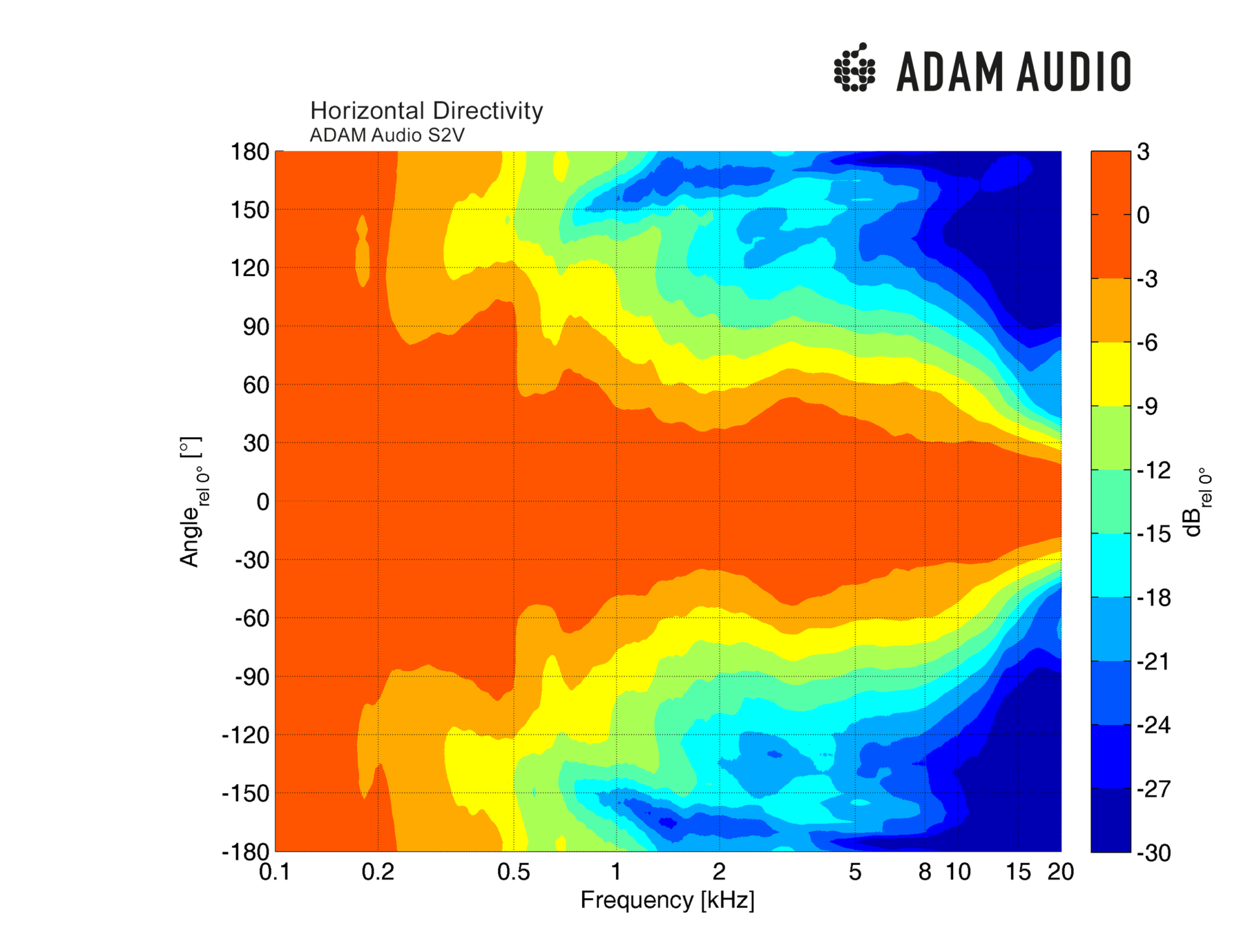
adam-audio-s2v-studio-monitor-horizontal-directivity-1920x1463.png
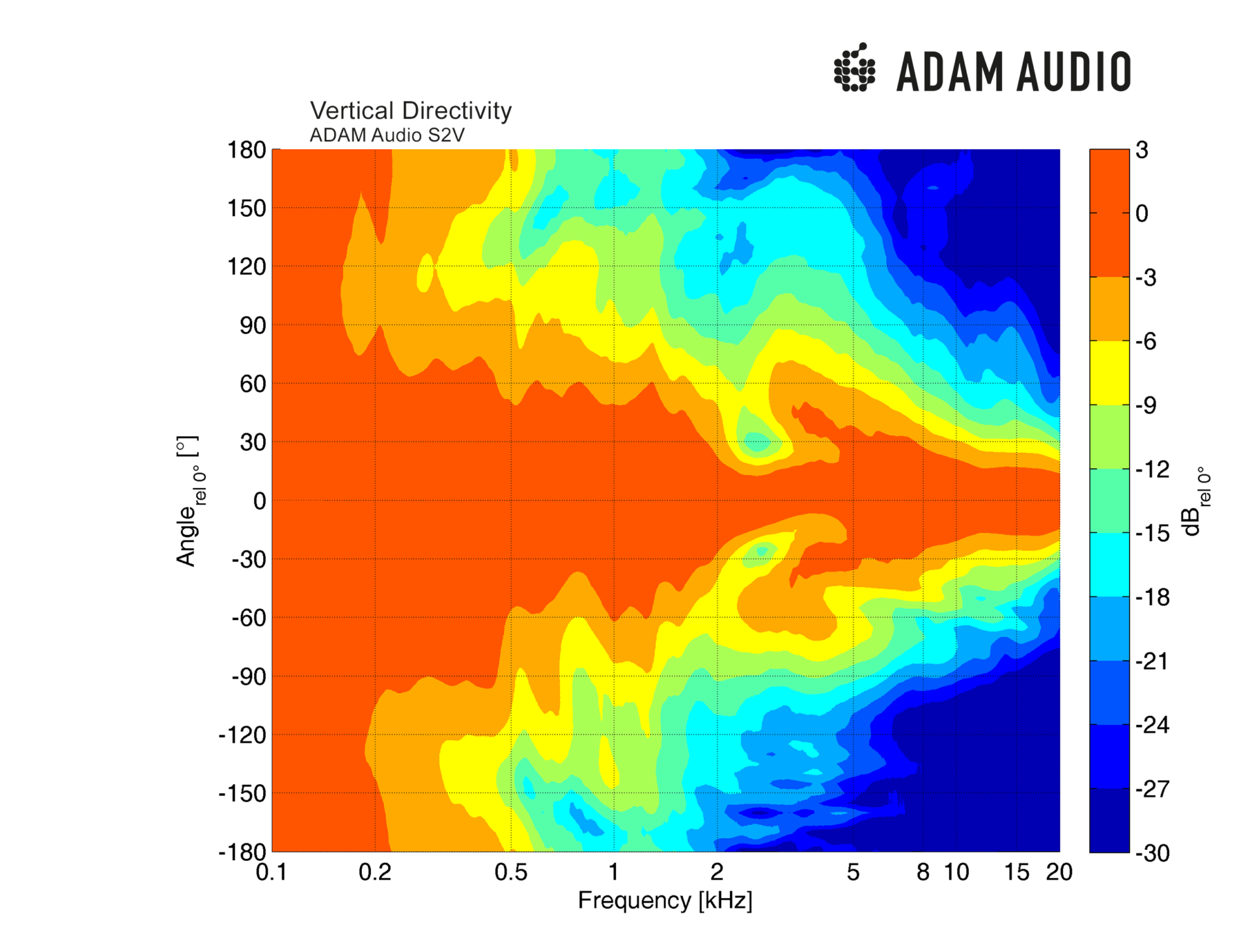
adam-audio-s2v-studio-monitor-vertical-directivity-1920x1463.png
 
I suspect this is a correction curve applied to the speaker on purpose, hoping that the room gain fills in the rest.
I plan to contact Adam and see if they have an explanation. And am open to suggestion and comments you may have on what may be going on.

I have no familiarity with the S2v, but looking at the manual (page 10) it looks like you can "voice" the speaker to your liking and room interaction through the DSP options.

"...a pair of shelving filters may be applied to the output [one for the low end, the other for the highs]. Six further fully parametric EQs with variable Q, center frequency and gain may also be dialed up via the display and encoder interface to boost or cut level at specific frequencies."

https://www.adam-audio.com/content/uploads/2018/03/adam-audio-s-series-user-manual-english.pdf
 
Is it possible that the shelf is there for reasons of placement, i.e., if they're on a mixing desk or something like that, the 2pi vs 4pi reinforcement?
 
I have these and really enjoy them. Upgraded from the Adam AX7’s. The AX7’s are quite nice, but the the S series is a whole different animal. You can get these for about $2800 a pair (ProAudio Star). Keep in mind that each driver (not speaker), has its own amp. Adam uses Class D’s. Subs are a great idea and I use two Adam Sub10’s in a really well treated room. The speakers are about 66” apart and I sit about 62” from each. As Pozz said, the vertical field is extraordinarily tight. That’s on purpose. It keeps the sound from bouncing off your mixing console. That’s Adam’s wheelhouse.

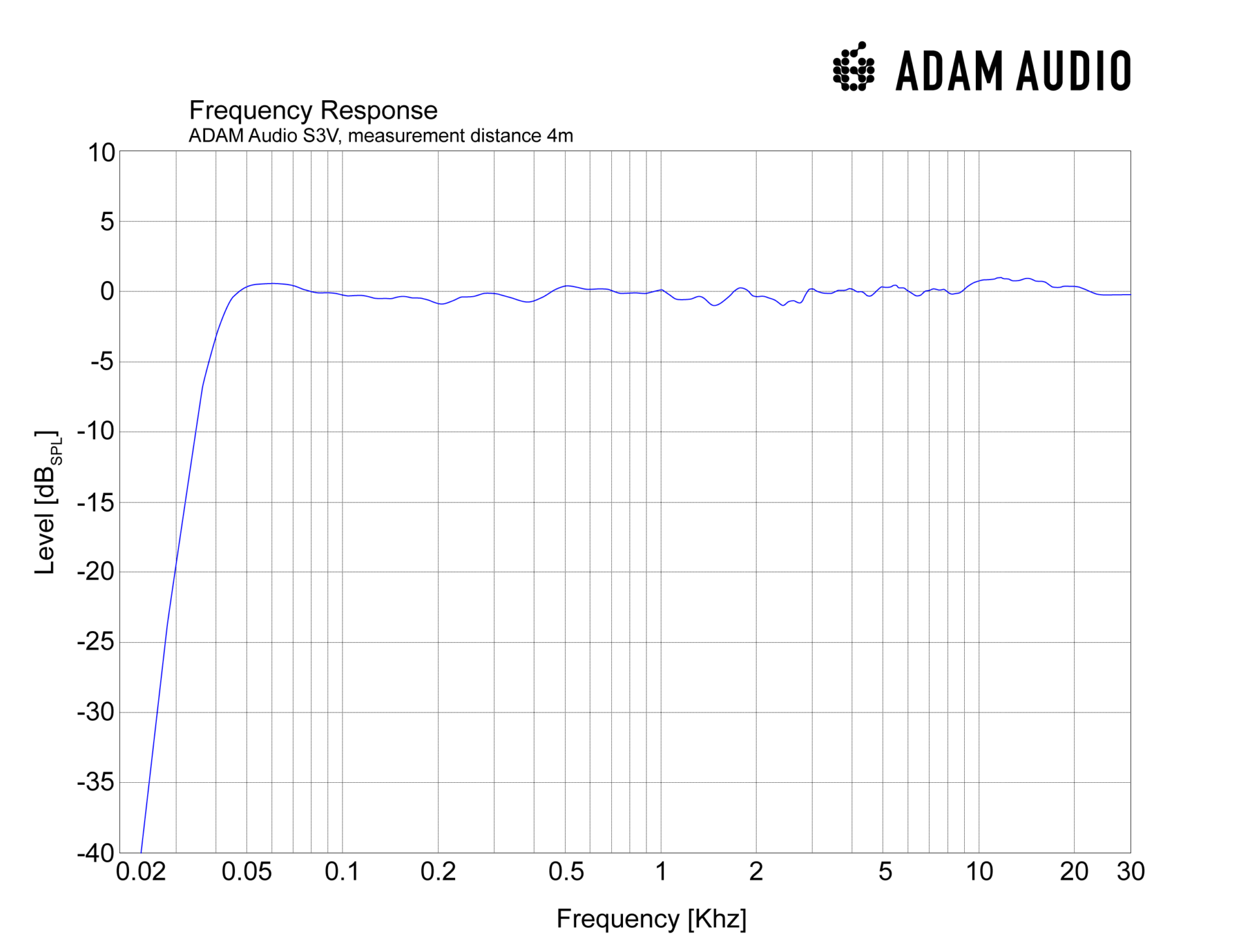
Something of an aside, I hate to admit this, but a mixing friend picked up the S3V’s and the midrange in those in fantastic. Thinking about going 3 way. You can get a Adam’s measurements on the S3V at https://www.adam-audio.com/en/s-series/s3v/ if you are so inclined.
 
Last edited:
Shelving :
Adam Audio's online user manual does mention about deliberate shelving + parametric setting through DSP to voice the monitor speakers to engineer's liking.
Regards
 
I was however able to select Analog input with Pure mode which is the factory preset for "flat" response.

So the speaker's sophisticated DSP was configured for a "flat" response. Yet the measurements show a very clear, very sharp shelf that really looks like some boundary compensation EQ that was put there on purpose. This is really puzzling. Would love to hear what the manufacturer has to say about this. This is a bit of a shame because without that shelf the response would likely look much more impressive.
 
Is it possible that the shelf is there for reasons of placement, i.e., if they're on a mixing desk or something like that, the 2pi vs 4pi reinforcement?

This is indeed about the frequency at which boundary reinforcement from a desktop would occur if the speaker were placed directly on it (woofer centre approx. 8" from surface). Still, I would have expected Adam to design the speaker to be flat out of the box and to leave calibration to the user through the included DSP functions. Also, if this shelf were in fact what they were trying to achieve to ameliorate desktop reinforcement, it shouldn't be nearly so sharp.
 
  • Like
Reactions: 617
Can the drop at approx 500hz and below be related to baffle step compensation and DSP settings?
The width of the cabinet equals to a baffle step frequency of 528hz, and height approx 335hz.
 
So the speaker's sophisticated DSP was configured for a "flat" response.
I think its DSP tuning was compromised between a flat on-axis and off-axis/power response.
If you see look at its directivity indexes

1581683186755.png


there is a significant directivity increase/jump at 500 Hz which was partially compensated by increasing the on axis frequency response from there to give a smoother predicted in-room response and power response.
 
Here is the company waterfall:
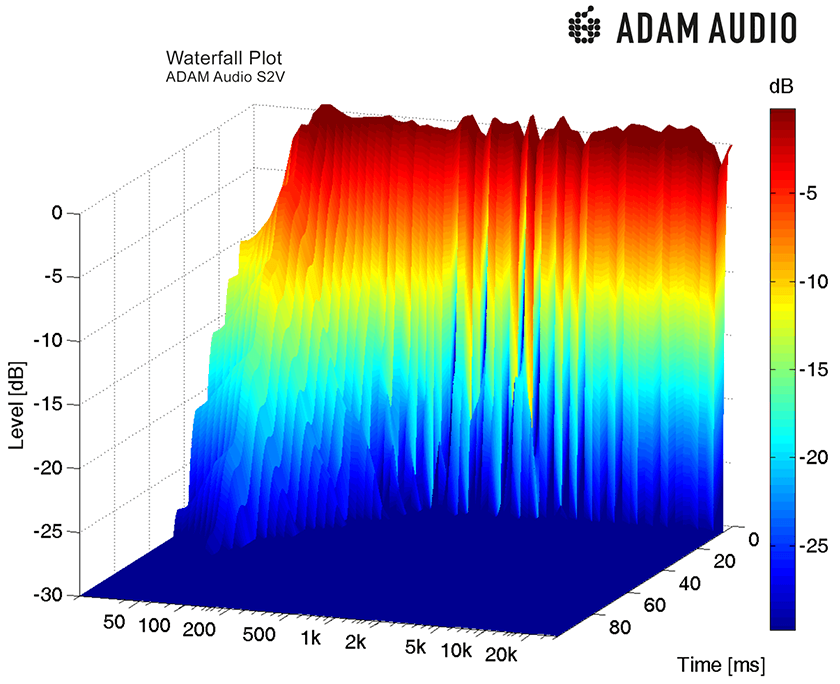
index.php


It is interesting in that it also shows the shelving response (top of the waterfall) which we have measured!

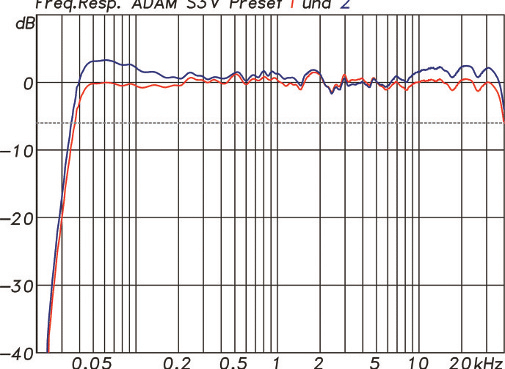
To me it does not seem so. Compare the amplitude at 3 kHz (the flat bit after the last spike before the HF rise) to the peak amplitude of the hump at about 150 Hz. To me, they seem very close to the same much more similar to ADAM's own FR data than your measurement which shows a difference of about 2 dB. Further, the dip before the peak at 530 Hz seems to have similar depth as the dips at higher frequency. The only difference I can make out relative to ADAM's FR data is the peak below 100 Hz which is likely due to the ports.
index.php

index.php

index.php
 
Thanks for the testing amirm.
Looks like a pretty decent speaker to me. After more have been tested I think the ideal flat response will be something of a dream.
 
Last edited:
This was my monitor..... .....The worst thing was the vertical directivity...

Great thanks share and amirm for analyze :).

In Spinorama plot can't shift reference angle for verticals as you say is worst, well maybe one could cheat it rename amirm's spin files so hor/ver is flipped around, but horizontals was a easy step all the way from critical listening angles out to the 180 deg toilet room like sound : )
pozz_ASR_hor_directivity_100mS.gif

100mS timeshift above get bit better readable or detailed using 1500mS:
pozz_ASR_hor_directivity_1500mS.gif
 
Great thanks share and amirm for analyze :).

In Spinorama plot can't shift reference angle for verticals as you say is worst, well maybe one could cheat it rename amirm's spin files so hor/ver is flipped around, but horizontals was a easy step all the way from critical listening angles out to the 180 deg toilet room like sound : )
View attachment 50182
100mS timeshift above get bit better readable or detailed using 1500mS:
View attachment 50183
Nice work @BYRTT!

@Koeitje I think you'd be interested in the above as well.
 
Thanks for this, and for stating the average error of ±0.8 for the scores on your Notes tab. From your charts though, the score for this speaker when used with a subwoofer should be 7.4 (rounded to one decimal place from 7.43), not 7.5.
Thanks, I was looking at the listening window score.
 
I'm surprised they managed to cross at 3kHz without a dispersion mismatch despite the large woofer. That's a well-designed waveguide right there. Many dome tweeter waveguides cross an octave lower to match dispersion. Also means the midwoofer is one well-behaved midwoofer. Now I hope we get to see NFS graphs of the HEDD Type 07, with a similar form factor.

The high crossover point smooths directivity between the two drivers since the tweeter is becoming more directional as frequency goes up. Mismatch is more pronounced with small tweeters crossed low, but this is a big one crossed high.
 
Here is a replacement Adam amt for another model:
https://reconingspeakers.com/product/adam-art1a-a7-tweeter/
I would expect this tweeter to be similar in quality to about a 120 off the shelf AMT, so not super high end but also not junk.

What's sort of funny about AMTs is that the good ones tend to just be really big. I've never seen a 1.5" AMT which is markedly better than another one of similar size. AMTs tend to have a really bad FR full of resonances so the speakers is probably doing a lot better with them than you could with a passive network.

ADAM and Hedd or whatever seem to be doing well with these (crossed over very high) but I would still favor dome tweeters in small speakers and CDs in big ones.
 
Back
Top Bottom