• Welcome to ASR. There are many reviews of audio hardware and expert members to help answer your questions. Click here to have your audio equipment measured for free!

A Pneumatic Loudspeaker Experiment Traveling Through Time: How Would You Measure It?

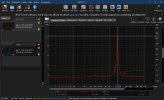
09-05-NF_sealed_DZ.jpg
exactly what you do
Which color curve am I theorizing about? Same conditions, same speaker, same input.
 
Thanks for the answers. I came here asking how to measure this system properly. Trying to fit it into a sealed-box model, and treating differences from that expectation as measurement errors, is rather the opposite of what I was asking for.

The post above has a simplified graph with fewer measurements to avoid confusion. All measurement conditions are the same, the only change is sealed box vs pneumatic configuration. The higher system sensitivity should come from using the second side of the diaphragm through the pneumatic system.

The measurements speak for themselves. Unfortunately, with my current equipment I cannot properly measure the complete system response.
Without meas instruments it is the way it is. Either find a lab which has the meas ability or invest into the needed gear when your theory is so worthy for you. I mean that you may get a lot of answers regarding meas instruments here and of course in the wide internet. The pros are here around.
 
invest into the needed gear when your theory is so worthy for you.
No need for investing, the OP theory is wrong. I read more diligently his GitHub project - it is a simple DBR (Double Bass Reflex) tuned uselessly low, described wrongly by OP as a pneumatic engine. A no go.
 
it is a simple DBR (Double Bass Reflex)

dbr_sealed_box_curve_paradox--.jpg


Sealed-box curve in a DBR box with increased sensitivity - I don't understand this. I understand only engines and pneumatics. :)

Sealed is one chamber, gentle roll-off, one peak. DBR is two chambers, two ports, steep roll-off, two peaks with a dip between. Open and closed should be very different around tuning if it were DBR.

My measurement shows a sealed-like shape, a single peak, a shallower slope than sealed, and the pneumatic system is louder than the plain sealed box in the same enclosure. OPEN and CLOSED compensator measurements are almost the same, so radiation from that opening is not the reason.

If you see DBR, please show me where the second peak is and where the steep roll-off is. A DBR with a sealed-like shape and higher sensitivity looks like something from an alternative reality. “Этого не может быть, потому что этого не может быть совсем.” - “It cannot be, because it simply cannot be.” :)

p.s. Vladimir found the project description here: https://github.com/DeltaSignum/Dynamic-Zero/blob/main/README.md
 
Last edited:
Will anyone actually substantiate the claims that this is a "sealed box" or a "DBR"? Although this was a complete diversion from the original topic.

Alternatively, if someone here has the equipment and facilities to properly measure a module - preferably a paired module - I can cover the cost of the materials and components. You would, of course, need to 3D-print and build it yourself. Send me a PM if interested.

I also updated the GitHub README with this functional/principle diagram, to make the intended DZ operating logic clearer.

DZ diagram-proportions.jpg


Full project: https://github.com/DeltaSignum/Dynamic-Zero/blob/main/README.md
 
Look very similar to George Augspurger's DCR

Thanks for your answer and the reference to Augspurger DCR 1961.
Idea of using the back side of the driver or creating a dynamic air mass behind the diaphragm is not new. The question is how it was implemented and how it actually behaves.

From what I understand, DCR is still a reflex system based on coupled resonant chambers and external port radiation. My DZ model predicts a different operating mechanism based on pneumatic state, timing and phase, as shown in the diagram above.

But I cannot adequately verify that mechanism with my present measurement setup. The measurements I have can be interpreted in different ways, which is exactly why I would prefer proper independent measurements rather than drawing strong conclusions from a 2" laboratory model and amateur measurement equipment.

Perhaps I will build a larger model in the future if audio community will be interested. I already experimented with a 10" version around 2000, the 2" model was built of some coincidences and because it makes some of these effects more interesting to investigate.
 
Last edited:
Look very similar to George Augspurger's DCR (double chamber reflex) concept. Main difference is Augspurger's concept had a port in the first chamber.
DCR is superficially similar, but DBR (Double Bass Reflex) is different and an older design.
First Double Bass Reflex enclosure was Acoustical Manufacturing Company (QUAD) Corner Ribbon Loudspeaker, by Peter Walker, in 1950:

DBR-Corner.png


There are two chambers (C2 and C3) internally connected with the first port/tube (M2), while bottom chamber (C3) is vented outside by the second port/tube (M3). Just like the DZ module by OP.
DBR enclosures were popularized later by Fostex.
 
Last edited:
it is a simple DBR

Measured frequency response of your loudspeaker is typical for a 2" loudspeaker in sealed box.

Which Vladimir is correct? Who can explain it to me? Or perhaps neither one is? Could this actually be a different type of sound reproduction, where resonance is not the operating principle?

Bass-Reflex = resonance. In the DZ system, resonance is a parasitic condition.

In BR/DBR, resonance is the tool.
In DZ, resonance is the enemy.
 
Last edited:
Which Vladimir is correct?
Both.
Any DBR, or any plain-vanilla bass-reflex box, if tuned extremely low, have frequency response typical of a sealed box.
Stop beating the dead horse - your DZ system has the same internal structure as DBR and can't be something different from DBR just because you believe it works on another principle.
 
Last edited:
Any DBR, or any plain-vanilla bass-reflex box
Can you substantiate your claims and comment on post #65?

1. Where is the first BR resonance peak? - is not an extremely low-tuned BR/DBR.
2. How do you explain the ~20 Hz downward shift of the Fs/transition region compared with the same driver in the sealed configuration?
3. How do you explain the minimal response to OPEN/CLOSED operation of what you describe as the second resonant port?
4. How do you explain the several-dB higher DZ output at the same 1.5 V input compared with the sealed configuration?

pressure_time_MOPA_deltasignum.jpg


The DZ model interprets this as a timing/phase interaction analogous to MOPA:

Raw past pressure in channel: p(t-T/2) — potentially destructive.
After Vc inversion: -p(t-T/2) — brought toward constructive phase relation.
Sum on membrane: p(t) + [-p(t-T/2)] — constructive contribution.

The same driver in the same enclosure changes from 113 dB sealed to 117 dB DZ at the same 1.5 V input. If this is simply an extremely low-tuned BR/DBR, how does that model account for this result together with the OPEN/CLOSED behaviour and the downward shift of the transition region?

My DZ model interprets these observations through timing, phase and inherited pneumatic state rather than resonance tuning.

P.S. The sinusoidal diagram is an educational illustration of the proposed mechanism, not a measurement curve.

Do you think everyone should simply rely on your “authoritative” fantasies while you ignore the measurement results? I am still waiting for comments on post #65.
 
Last edited:
You need to gain a much deeper understanding of the theory, practice, and measurement of loudspeakers, than your present knowledge. I gave you enough information; you are on your own now. And I don't like your tone - you are on the ignore list now.
 
I still don't understand what the DZ operating principle is as you haven't produced a model for it beyond a few incomplete analogies. Unless I've missed it you haven't produced a worked example of your DZ model applied to the driver parameters and 3d printed enclosure, showing a theoretical response either at the driver or the outlet of the port. You haven't presented any measurements at the port either. That might help the rest of us understand why you think it's different to the DBR with the conventional model. There's also no worked conventional DBR model to show why it doesn't apply to the response of your 3d printed one.

I may be misunderstanding the intention of the ICE+exhaust analogy in #26 but the intent there is usually significantly different to that in a speaker. The tailpipe has to be open as there has to be a net flow, pulsed at the ICE end but with the pulses significantly reduced (ideally zero) at the tailpipe. Applied to a speaker there would be no net flow, and little or no acoustic output at the port end. In the DBR the intent is usually to produce acoustic output at the port end, so the system tuning is completely different to the exhaust, even though the underlying physics remains the same (ignoring the thermal component that complicates the exhaust situation somewhat).
 
  • Like
Reactions: SSS
You need to gain a much deeper understanding of the theory, practice, and measurement of loudspeakers, than your present knowledge. I gave you enough information; you are on your own now. And I don't like your tone - you are on the ignore list now.
nicely arrogant, good way to keep it running for sometime, but the truth will come out anyway..
 
nicely arrogant, good way to keep it running for sometime, but the truth will come out anyway..
And 'the truth' would condensate to what endpoint?
Just curious....
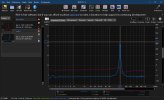
 
Impedance measurement: DZ vs. sealed

P.S. I could not get rid of the permanent internal loop in the sound card with the CM106 chipset, so it was not easy to configure the system for someone like me from the past. :)

DZ vs. sealed pneumatic configuration, same driver.

dz_vs_sealed.jpg

sealed_impdc.jpgDZ_impdc.jpgimpdc.jpeg

The sealed configuration shows its main impedance resonance at approximately 200 Hz, while the DZ configuration shifts it down to approximately 170 Hz — a shift of about −30 Hz. At the same time, the impedance peak does not decrease: it increases from approximately 22 Ω to 25 Ω (+3 Ω).

Fs of this driver is approximately 168 Hz.

The +3 Ω together with the −30 Hz shift: my current working interpretation is somewhat analogous to a hybrid powertrain. Instead of the voice coil working against the pneumatic system alone, part of the pneumatic state inherited within the DZ system may assist the following motion. This is my interpretation of the measurement, not proof.

So rather than arguing about terminology, I would be interested in a conventional sealed-box explanation of the measured difference:

How does the same driver change from ~200 Hz / ~22 Ω in the 0.35 L sealed configuration to ~170 Hz / ~25 Ω with DZ, despite the DZ configuration adding only ~0.12 L of internal volume?

If the claim is that DZ is effectively just the same sealed enclosure, or a double-, triple-, or whatever bass-reflex system, a conventional lumped-element model should be able to reproduce both the −30 Hz resonance shift and the simultaneous +3 Ω impedance-peak increase.
 
Last edited:
An Internet rando discovering something that has eluded legendary speaker designers and R&D-intensive, PhD-staffed, patent-rich corporations like JBL for 80 years.

Hey, even blind pigs find truffles sometimes. But mostly, they don't.

@DeltaSignum there's really only one way to settle this: pack your speakers and send them to ASR - you know, Audio Science Review - and let experts do what they do. What do you have to lose?
JBL and other companies have optimized loudspeakers for their design goals, production methods and market requirements. That does not mean every possible acoustic architecture has already been explored.


DZ is not presented as a replacement for all conventional loudspeaker systems. It is an open experimental project. The CAD, code and documentation are public specifically so others can reproduce and measure it.


ASR measurements are valuable, but the measurement method should match the system being investigated. DZ is intentionally based on a coupled pneumatic/mechanical behaviour, so the interesting part is not only the final SPL curve.


You don't have to trust my interpretation. Build it, measure it, and publish the results.
 
Back
Top Bottom