• Welcome to ASR. There are many reviews of audio hardware and expert members to help answer your questions. Click here to have your audio equipment measured for free!

A Broad Discussion of Speakers with Major Audio Luminaries

Well, my perception/experience is different. I hear a sense of space on pretty much every recording I have, and it doesn't really matter to me whether that sense of space is real or engineered or both. I want to hear it, and I enjoy hearing it.

Exactly! I would go so far as to say it is one of the more important aspects to really enjoy a recording.
 
If I put on something like this quite modern track and close my eyes on my reference (stereo) system, I literally feel like I'm inside the music, and with just two channels. I think this experience is awesome.

 
I guess my point is that re-creation isn't the only way to gain perceptually from upmixing. Since we are discussing popular music that didn't involve a performance space at source, and said music is a sonic production from go to whoa, then a somewhat more relaxed and hedonistic attitude is justified. Like Floyd says a few posts up, it is routine for sound engineers to add some artificial reverb, because the perceptual gains are indisputable.

Anyone, perhaps not you, arguing that upmixing would be automatically a loss (of originality, per the 2-channel original) is trying to have their cake and eat it too. The sound engineers know what could have been done with a discrete spatial mix, both in terms of musical spatial arrangement and in terms of sense of space. So they know what a big loss it is, to their creative opportunities to create listener pleasure, when they are instructed to produce from their multichannel masters a 2-channel mix for playback in small rooms on 2 speakers. Upmixing from 2-channel is not 'a loss', it is an attempt to imperfectly claw back some of the losses that were inevitably incurred by the decision to make a 2-channel production.

If there had been production standards for 2-channel production, or even some embedded metadata requirements, then upmixing could have been significantly more successful and reliable at creating perceptual gains. But it is still somewhat successful.

Conclusion: upmixing of popular music still enables perceptual gains in the quality of reverberation, and also there seems to be some spatial rearrangement of the music itself, however imperfectly, moving beyond the front two speakers. Focusing on the positives (not on a discussion board, but in your listening seat) is key to justifying it.

cheers

Production standards ? I would be happy if music got the same treatment as movies . For example a calibration level so we know how loud a records is supposed to play, at least that :)

Some genius engineers will always claim that they can make anything “translate” on every volume on every audio device ? I’m not believing this is always the case due to the simple fact the timbre changes with volume, there is a niche for better recordings that may not always sound amazing on your Bluetooth speakers.
 
OK, I understand the objective, but elsewhere in these forums I have said that upmixing is a lottery because of the numerous uncontrollable variables: the recording, the upmixer, the directivity patterns of the loudspeakers and geometry and reflectivity of the rooms, and the personal preferences of the judges/listeners. It is a fundamentally confused scenario in which the outcome is not assured. No scientific research is required to prove it.

That is why in my earlier post I said "good stereo upmixing" because there are so many opportunities for bad stereo upmixing. In my experiences I have had to manipulate the parameters of the upmixer (when it was possible) to optimize results for individual recordings. Then there were recordings for which the only satisfying setting was "off". This is clearly a topic area for experimenters who have patience.

At one time, not many years ago, I would have argued that the audio industry should get its act together and create a standardized system that has some assurance of having the art "translate" to homes in all of its aspects. That quaintly old school perspective assumed that significant numbers of homes had recognizable stereo systems, such as appears to be the case with ASR forum members. But we are vastly outnumbered by people who are adequately rewarded by listening through soundbars, smart speakers, headphones and in cars.

The common element is the music, which "translates" sufficiently through all these delivery systems to provide enjoyment. From the sound quality perspective, science and technology have resulted in much improved and sometimes quite impressive results at modest cost. From the "soundstage and imaging" perspective, there is great variability. So, if there is an interesting line of enquiry for science at the moment, it would be to ascertain just how important those elements of perception are in the total satisfaction listeners derive from listening to music.

In my present living situation I actually spend some of my time with my laptop in my lap, my feet up, seated off axis, where I can enjoy a nice view through our picture windows, listening to high quality stereo reproduced in a room with no bothersome resonances. Ideal? Not at all. Enjoyable? The music gets through very well. The sound quality is good. There is a sense of ambiguous "space". I know what the missing spatial elements should sound like, and my imagination fills in the blanks. I adapt to the circumstances.

Soundstage and imaging are not part of the music, they are part of a narrow, very traditional, set of expectations based on live performances experienced from the expensive seats, near center audience and not too far from the orchestra. In typical concert halls only a small fraction of the audience gets to hear it. Where one sits makes an enormous difference, and few can afford the good seats. Stereo, even mediocre stereo, may be better than what is heard by many live audience members in affordable seats. Fortunately the sense of large space envelopment is more generously perceived throughout the audience, but not everywhere in all halls. Attending a live classical concert is no assurance of hearing all that there is to hear.

Both stereo and multichannel sound had their origins as enhancements to movies, and for me at least, movies benefit significantly from multichannel reproduction. Putting the viewer into the acoustical space that is portrayed on the screen is an obvious enhancement. Again, only a fraction of the cinema audience gets to hear the full splendor of the soundtracks, so a good home theater may be an improvement (to me it has been in both sound and spatial qualities). I often wonder why so many people gravitate to the side or rear seats in cinemas - so much is missed. Stereo and headphone reproduction provide useful spatial/directional cues, but are compromised. Mono succeeds only in conveying dialogue and plot. Movie mixers have worked with multichannel audio for decades and have become good at it. Music mixers schooled in stereo have demonstrated some problems adapting, but a new generation is coming along.

So, perhaps stereo upmixing cannot deliver predictably beneficial outcomes from all recordings in all playback situations, but it may still be a worthwhile feature to have available.

Great post!

Can I just gush a bit about how much I (and others obviously) appreciate that you bring a wonderful mix of presenting scientific facts, but also informed speculation, and personal opinion. (carefully expressed as such when appropriate, of course). The picture given is informative, nuanced and not dogmatic. Wonderful.

If you don’t mind, I have a question about the role of adding a centre channel and whether it can positively affect the impression of instrumental timber.

I’m wondering if a perception I have makes any sense to you.

It’s long been my impression that music played through stereo systems sounds more homogenized than real life. Obviously highly colored loudspeakers will exacerbate this issue, but I still perceive it even in well designed, low colouration speakers. Whether this has anything to do with the limitations of loudspeakers themselves or the nature of recordings, not sure. But there is what I think of as a “ surprisingness” to the range of instrumental timber I hear from real acoustic instruments that I just don’t get from sound reproduction.

I find, however, that when I listen to music on my surround system (either recorded for multichannel or when upmixing stereo) and I switch from stereo to deploying the centre channel, not only does it add scale and density to the presentation, but it seems to add timbral richness: a somewhat better sense of timbral variety to the sound - metal sounds a bit more metallic, wood sounds a bit more like wood, string instruments more differentiated from woodwinds, etc.

If this perception is correct, would this be one of the advantages of adding a centre speaker?

I’ve had a layman’s intuition as to why I’m receiving this in my system:

My L/C/R speakers are designed by the same manufacturer and they are very well designed and they sound beautifully even and coherent. But not perfectly so. Especially since my left and right speakers are on stands to the side of my projection screen, and my centre channel had to go on a stand below my screen. So along with the design differences of the centre channel, they’re gonna be facing somewhat different boundary conditions as well.

The Audyssey room correction from my AVR does move them even further to invisibility and coherence, though with the cost that I don’t quite like the timbre as much.

Anyway, since there is a very slightly perceptible mismatch between the sound from my centre channel and my left and right speakers, I’m wondering if that in itself is adding to this impression of “ greater timber variety and richness” to the music. Because… I’m in fact adding another source of sound in the room that DOES have its own slightly different spin on the recording, and so perhaps this adds some perceptual richness that I’m trying to describe. Almost analogous to if I had two identical saxophones playing in each corner of the room, and now I’m adding one more in the centre that has a slightly different timber or maybe is even slightly de-tuned. Now the sound is richer.

Does this make any sense?

Or if one had a perfectly coherent L/C/R set up, would perhaps the sense of timbral richness I’m trying to describe also be enhanced?

Thanks
 
Last edited:
Anyone, perhaps not you, arguing that upmixing would be automatically a loss (of originality, per the 2-channel original) is trying to have their cake and eat it too. The sound engineers know what could have been done with a discrete spatial mix, both in terms of musical spatial arrangement and in terms of sense of space. So they know what a big loss it is, to their creative opportunities to create listener pleasure, when they are instructed to produce from their multichannel masters a 2-channel mix for playback in small rooms on 2 speakers. Upmixing from 2-channel is not 'a loss', it is an attempt to imperfectly claw back some of the losses that were inevitably incurred by the decision to make a 2-channel production.
(emphasis mine)

I don’t want to misinterpret the above, so I’m a bit confused and could use some clarification.

When you write “ multi-channel Masters” did you perhaps mean to reference “multi track masters?”

If you did mean multichannel, then I can see your point: if you’re talking about mixes that were already made for multi channel (surround), but if the engineer who did that was instructed to release them in two channel instead, then yes I could see the point that the stereo mix would not represent their preferred mixing choice for that music, and that upmixing stereo imperfectly moves a bit more towards the type of experience they might have provided us.

But that, of course would represent an extremely teeny proportion of recorded music, and here we are talking about upmixing stereo in general, not those that came from fold down of a multi channel mix.

And that’s why I suspect you were actually referencing “ multi track” recordings, standard practice for music production even the stereo? And implying such multi tracking implies the opportunity to create a surround mix, which sound engineers would’ve preferred, but were forced to mix in stereo?

If you mean the latter, I can’t see how that is plausible. The vast majority of stereo recordings were created with the intent of being stereo recordings. That’s what the engineers intended. They weren’t done under the pressure of “ we’re not going to let you do a surround mix, we’re forcing you to make it in stereo.” That’s simply what the engineers and artists expected and intended.

I’ve been in bands whoever recorded the studios and also attended numerous other studio recordings, and not once was it suggested by engineers or anybody else
“ boy we’d really like to be doing this and surround.” It just wasn’t a thing. The stereo mix was the only intention anybody had.
And I’m certain that goes for most stereo recordings.

Now with Dolby Atmos, etc. starting to take off there certainly may be more engineers gaining a preference to be able to make a surround like that when they can.
But stereo is still by far the vast majority (and you can find pushback against Dolby Atmos by some engineers).

So again, if the suggestion was that most sound engineers were working in stereo with the opinion they would rather have mixed in surround… I don’t think there’s adequate justification for that.

Conclusion: upmixing of popular music still enables perceptual gains in the quality of reverberation, and also there seems to be some spatial rearrangement of the music itself, however imperfectly, moving beyond the front two speakers. Focusing on the positives (not on a discussion board, but in your listening seat) is key to justifying it.

Now I’m with you! This mere fact that stereo recordings upmixed surround can sound very pleasing is justification enough.

I’m not even working with the very best possible upmixing - just the various matrixes offered by my Denon AVR. But I find upmixing to be plenty pleasing. I particularly like it for watching music videos and music performances on YouTube in my home theatre as I was last night. In some cases when the matrix just extrapolates the ambiance and spread it around the room, that’s a nice sense of immersion while the instruments are still kept upfront.

On the other hand, I can also enjoy some of the other settings which are a bit more aggressive and can even place some of the instruments in the surround speakers. That can be really fun too on the right music.

I was watching some awesome performance footage last night of Anyma. Man… on the big screen, high resolution, and the music in surround, the sense of “ being there” is beautifully enhanced.

That also goes for watching lots of the footage people are uploading of the new Rush tour. On the big screen with the right up mixing, I get a big vibe of being at the concert… while sitting on the most comfy sofa in the place :-)

Cheers
 
Last edited:
First off, @Floyd Toole, thank you. My life has been enriched by your, and others, research and efforts; including to explain your perspectives to a bunch of forum dorks!

My own perspective is that there is room for differentiation of quality within speakers, despite performance convergence and associated preference of a more specific set of targets. Humans enjoy novelty- there's room for maggies and revel, full scale horns and fullrange micromonitors. The reality that the setup should change with the speaker and different speakers suit different spaces and priorities means that our convergent solutions aren't really ever going to "lock in" until we have a structural change in the technologies, the closest I think is massively arrayed active systems, which I've only really seen used in a yamaha soundbar which had, IIRC, 64 channels of DSP/amp, but there are similar things being done with less traditional tech (directional vending machine sound using ultrasonics and summation to create high specificity soundzones).

My solutions have converged upon needing "splash" because I want to have my cake and to eat it too- extremely high image specificity but also pleasureable envelopment. Without exciting more of the room, horns can sound thin, lack intelligibility, or even sound boring- boring with horns!! If you want decent time-domain behavior you have to use a lot of absorption, and that just makes it worse! At the moment my horns are supplemented with a pair of splayed, waveguide-loaded coaxes per side, on a 17ms delay with a downward FR tilt (like 3x the tilt of the room reference curve we all know and love). I do this with DSP, @Duke has done it with rearfiring elements (using pathlength to create delay). I've found that as some others have described, there's often a "lock in" point- too quiet and the splash seems to add nothing, too loud and the image suffers, but just right and when you mute the channels it doesn't sound quieter so much as it sounds like less space. The same sort of finding the "just barely there" approach works for setting up subs with music as well as for rumble.

Of course doing this has required a lot of channels- and DSP. I'm on 14ch used of my 16ch dsp, and I only have 2 surrounds and no center. It's almost all stereo (active XO in DSP), subs, envelopment.
 
... our convergent solutions aren't really ever going to "lock in" until we have a structural change in the technologies, the closest I think is massively arrayed active systems, which I've only really seen used in a yamaha soundbar which had, IIRC, 64 channels of DSP/amp...

Not familiar with that Yamaha soundbar, but if it uses wavefield synthesis, that has been criticized as being inferior in perceived sound quality by Francis Rumsey, if I understand correctly, due to the inevitable horizontal-plane comb filtering caused by having physical spacing between the transducers. Perhaps a future technology will use a continuous transducer rather than discreet individual transducers.

My solutions have converged upon needing "splash" because I want to have my cake and to eat it too- extremely high image specificity but also pleasureable envelopment.

Yup!

Without exciting more of the room, horns can sound thin, lack intelligibility, or even sound boring- boring with horns!! If you want decent time-domain behavior you have to use a lot of absorption, and that just makes it worse! At the moment my horns are supplemented with a pair of splayed, waveguide-loaded coaxes per side, on a 17ms delay with a downward FR tilt (like 3x the tilt of the room reference curve we all know and love). I do this with DSP, @Duke has done it with rearfiring elements (using pathlength to create delay).

That all sounds great!

I've found that as some others have described, there's often a "lock in" point- too quiet and the splash seems to add nothing, too loud and the image suffers, but just right and when you mute the channels it doesn't sound quieter so much as it sounds like less space.

We once calculated that the SPL increase we were getting from the additional late-onset reflection energy was in the ballpark of .3 dB (three-tenths of a decibel) at the listening position. But, in subjective terms, it seems to make the difference between "kinda dry" (with horns, which otherwise can do a whole bunch of things well) and "rich, enveloping, and more engaging."

Our observation as been that, with good initial set-up, there doesn't seem to be any downside. It seems to be "set it and forget it".
 
Last edited:
... the closest I think is massively arrayed active systems, which I've only really seen used in a yamaha soundbar which had, IIRC, 64 channels of DSP/amp, but there are similar things being done with less traditional tech (directional vending machine sound using ultrasonics and summation to create high specificity soundzones). ...
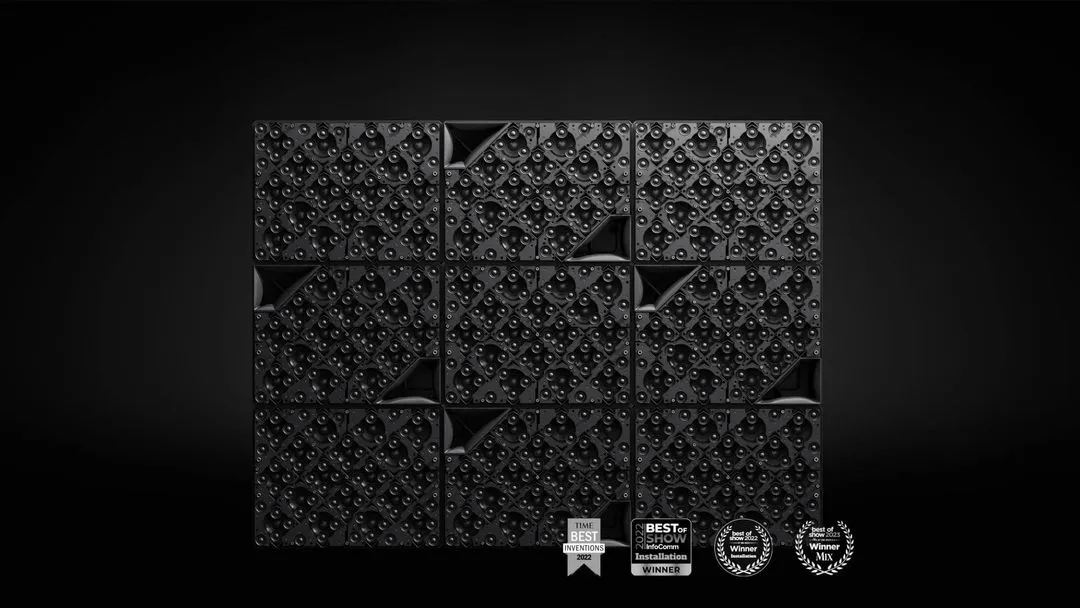
The current SOTA implementation of wavefield synthesis, I believe at least for those commercially available ones, is by Holoplot. The system/technology is used in the Sphere at Las Vegas (in fact the company behind the Sphere has acquired Holoplot).

Don't know how well (or whether) they have overcome the spatial aliasing problem as described by Francis Rumsey.

6852ca529b1abdcc1d78ef40_X1_Main_Banner_Desktop_-p-1080.webp
 
Back
Top Bottom