• Welcome to ASR. There are many reviews of audio hardware and expert members to help answer your questions. Click here to have your audio equipment measured for free!

1966 Bulova Accutron Astronaut GMT (Caliber 214) Vintage Watch Review/Measurements

Omega watches allow more braggin' rights than Bulovas but that is my penny's worth!
And for my dime; I would have to concede that my 'unobtainium' is a simple 3-handed Panerai.

Panerai's reputation is mud among watch collectors. Unfinished or minimally finished ETA movements in fancy cases. Doing away with visible watch backs in "limited editions" so that you can not see the unfinished movement inside whilst charging you more.
 
At times, I get this notion that I should resurrect one of the Accutrons in my inventory but it appears that their SINAD seems absolutely deplorable.
I am afraid that my "audiophile" creds would be ruined if I rejuvenated one with a new battery and wore it.
Deplorable SINAD means "audiophiles" will think it's the most awesome device ever made :D
 
Have a Bulova spaceview. Problem is that the original battery type is not available anymore, at least here in Germany. If the clock was not maintained like mine then the timing interrupts intermittently. But I will keep it as remembering to the age prior to quartz clocks. Nice look.
 
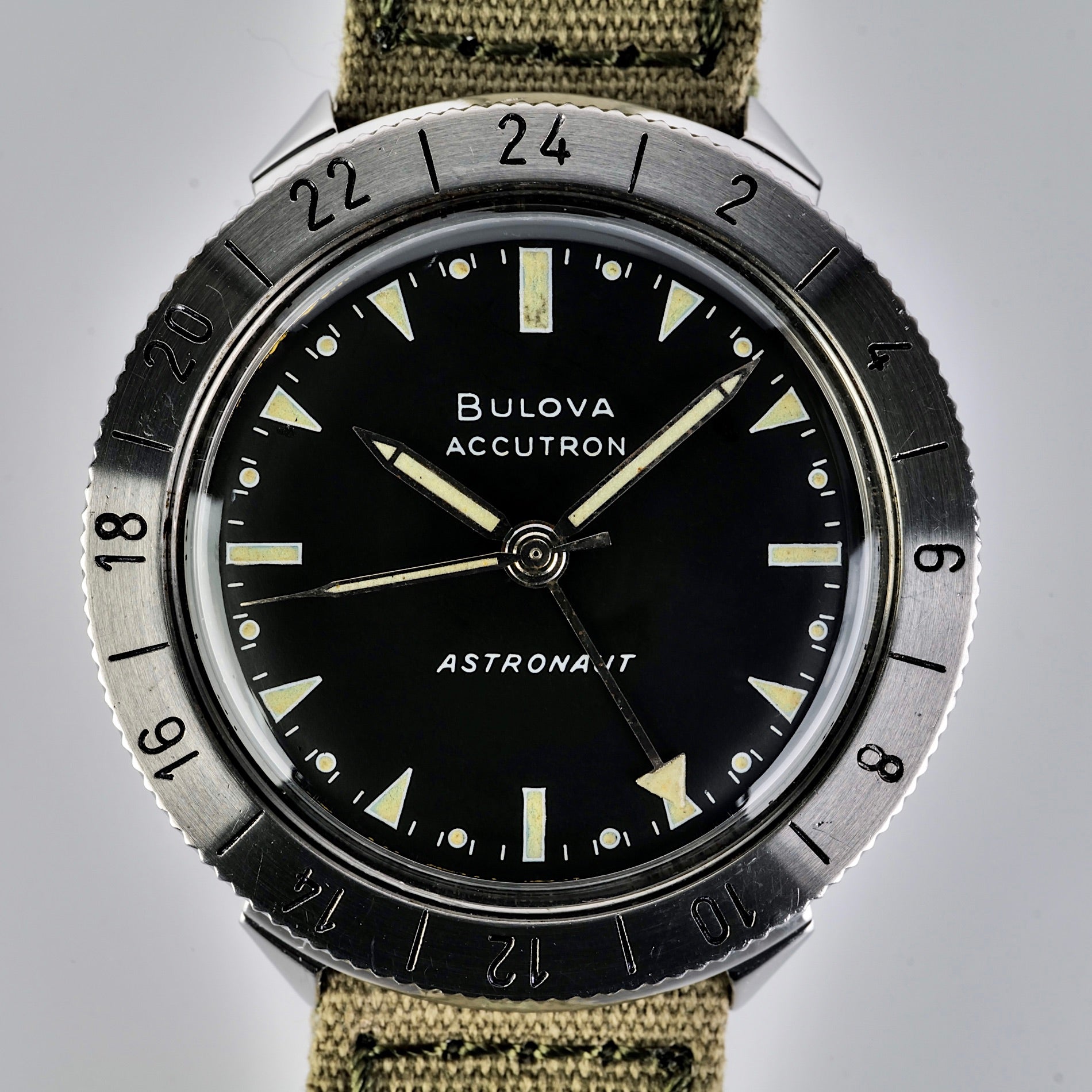
1966 Bulova Accutron Astronaut GMT Vintage Watch Review with Measurements

PhotoMar022023_54113PM.jpg


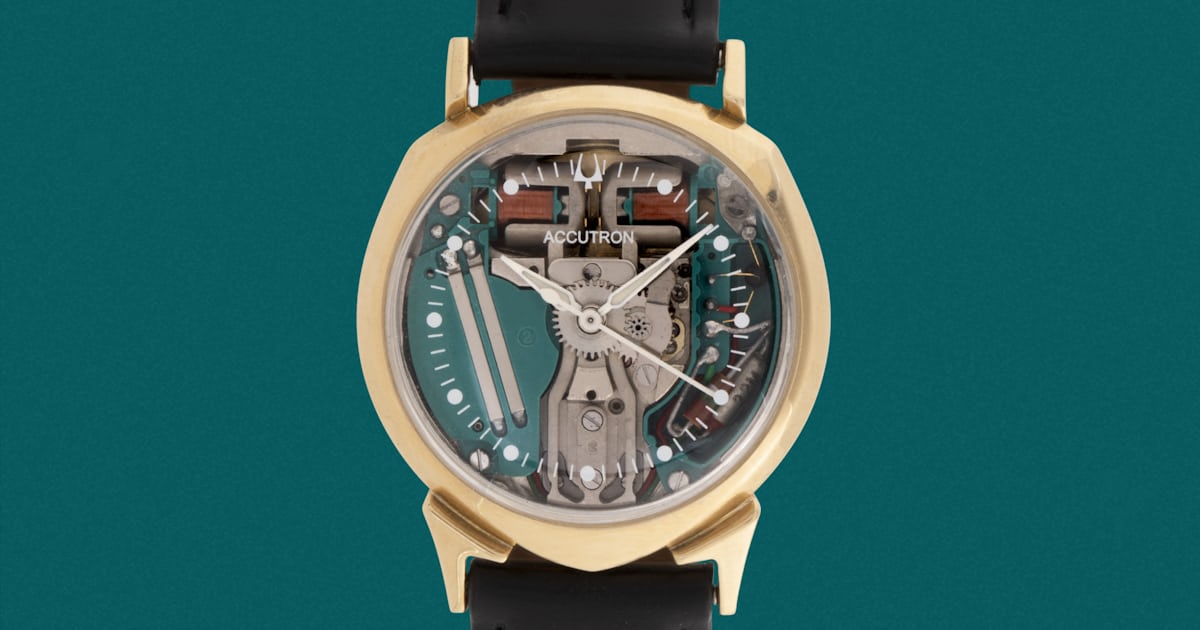
"The Accutron movement made its official appearance in October 1960. Designed as an electronic movement, the Accutron, designated the Caliber 214, utilizes a 360 Hz tuning fork and battery to replace the traditional balance wheel and spring. The Accutron movement was so precise and capable of handling extreme temperatures and pressure, that NASA utilized it in the instruments of the Gemini and Apollo cockpits. Chosen by the CIA for wear during missions with the A-12 and X-15 aircraft at the height of the Cold War, the Accutron Astronaut GMT has become a symbol of ingenious engineering and design, as well as a piece of aeronautic history."

Hodinkee has a great advertorial on the technology.

View attachment 270554


Specifications
1966 Bulova Accutron Astronaut GMT
Caliber 214 with rated 99.9977% accuracy; 360 Hz
Acrylic crystal
38mm case width
13.5mm case height
17mm lug width

Test Setup
A UMIK-1 pointed toward the watch. Windy and rainy day.
Given that the ambient noise is so high relative to the signal, the THD+N is impossible to interpret.

Objective Results
Using @JohnPM 's REW's RTA function, you can see that the tuning fork in the Accutron watch had a measured frequency of 360.01 Hz. It should be 360Hz.

View attachment 270541

Looking at the manufacturer's advertisements, it should offer 99.9977% accuracy...
View attachment 270593

I repeated the measurements again, and this time with shorter FFTs and this time, REW actually reported a measurement of 360.00 Hz.
View attachment 270569

In order for this 57-year-old watch to meet the advertised specification, it should not run faster than 360.008 Hz. Since REW rounds to two decimal points, it's very possible that this watch is continuing to meet its advertised performance. It is certainly safe to say that it is "at least 99.9972% accurate" which is only a maximum deviation of 0.0005% from the advertisement even though the real accuracy is likely better.

Next, I ran the watch through @pkane 's Multitone Analyzer. Here, I told the software to generate a 360 Hz tone so that it could assign a jitter value but no audio was being played. This is just the recording. The Multitone Analyzer software does not account for the UMIK-1's calibration but the range from 360 Hz to 1800Hz (for H2 and H3) is 0.177 dB to 0.003 dB of variance.

View attachment 270543

With 2M FFT and 128 averages, the rms-jitter was an impressive 6.1 microseconds. That's great for a 57-year-old watch!

Measuring it again with a smaller, less-precise FFT, and fewer averages, I was able to get a result showing "zero" measurable jitter.

View attachment 270574

Subjective Impressions
No firmware update was needed. I experienced no crashes or compatibility errors during my testing.

The Accutron was easily ABX'able against several mechanical watches in collection. The watch was free from any extraneous "ticks" or "tocks." Imaging was poor though the dispersion was superb as the 360 Hz tone was consistent on- and off- axis.

When assessed in a non-blinded fashion, my impression was that the second hand glided effortlessly without any of the jitter seen with mid-fi quartz watches, nor the "grain" one sees in the seconds hands of mechanical watches. There were no microphonics against the watch case which can be heard with many mechanical watches. In my opinion, the smoothness of the Accutron's seconds hand was equal to the performance of watches costing several times its price, including a $103,000 platinum Grand Seiko with a 9R02 Spring Drive.

Although "burn-in" is considered an audiophile myth, I am confident that the luminescent hands were brighter without being shrill after exposing the watch to bright light. The enhance visibility of the luminescent hands quickly faded though, potentially suggesting that I was adapting to the product or the burn-in would be better described as warm-up. Given the energy efficiency, I certainly recommend leaving it on all the time and keeping the watch exposed to bright light before relying on the luminescence.

View attachment 270577

Conclusion
Highly recommended. PRaT (Pace, rhythm, and timing) was beautiful. This watch easily performs as well or better than watches even 10 or 100 times its price. There are certainly better-measuring solid-state watches out there and certainly more musical mechanical watches for true audiophiles in search of luxury and exclusivity. Based upon my experience, however, the Accutron Caliber 214 certainly is worth an audition.

@amirm @LarryRS @rdenney @watchnerd @pseudoid

Love this I needed a chuckle.
 
Have a Bulova spaceview. Problem is that the original battery type is not available anymore, at least here in Germany. If the clock was not maintained like mine then the timing interrupts intermittently. But I will keep it as remembering to the age prior to quartz clocks. Nice look.
If I remember stuff from my dad, there's a slightly smaller battery that works, but maybe it has lower capacity. My dad was wearing it daily and it worked until 7 years ago when he passed.
 
Have a Bulova spaceview. Problem is that the original battery type is not available anymore, at least here in Germany. If the clock was not maintained like mine then the timing interrupts intermittently. But I will keep it as remembering to the age prior to quartz clocks. Nice look.

Thankfully in the US, we can still get batteries.
 
My dad bought one about 1966 and wore it everyday until about 1973 when he gave it to me as a present for elementary school graduation. I wore it everyday until about 1980 when the battery ran out and I couldn't find a new one. Still have it. I should have it serviced...Neat watch.
 
Have a Bulova spaceview. Problem is that the original battery type is not available anymore, at least here in Germany. If the clock was not maintained like mine then the timing interrupts intermittently. But I will keep it as remembering to the age prior to quartz clocks. Nice look.
Hope this helps (circa ~2008)... as was told to me by an old "timer" horologist-turned-salesman for Tourneau.
P1160612.JPG

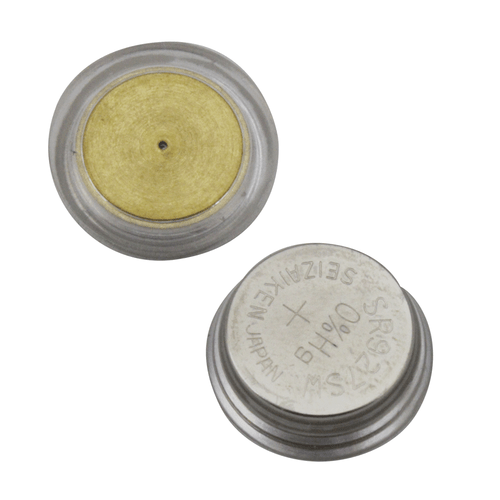
The chemistry of those 1.35 V. batteries is based on mercury oxide. The sale of mercury batteries was banned in 1996 because of their toxicity and environmental unfriendliness, and, unfortunately for the owners of camera of the early 70s, there is no perfect substitute. For all of their drawbacks, mercury oxide batteries had two big advantages – they delivered a constant 1.35v tension across their lifespan, and if not used, they kept their charge for a very long time (at least 10 years).
From <https://cameragx.com/2020/02/12/replacement-for-mercury-batteries-2/>
 
Last edited:
I am going to regret not searching further at the current time since I have no desires to resurrect any of the four in my inventory... YET!
PX400 / MR42 / Bulova 218
$ 12.95
AVAILABLE FOR THE FIRST TIME IN 30 YEARS!
MANUFACTURED UNDER THE SPECIAL REQUEST IN APRIL 2022.

LONG LASTING! Provides precise and stable voltage throughout the entire life span!
Type: mercuric-oxide. Diameter: 11.6 mm. Height: 3.6 mm. Capacity: 105 mAh. Weight: 1.6 g
Replaces: 343, MR42, MR1136, 509, Bulova 218, Timex B, Citizen 280-05, NP343, HG11, M08, 1154M.
Works as a PX400 battery replacement! Tested with an original Asahi Pentax Spotmatic*

From <https://mercurycell.org/#!/tproduct/375421238-1498486363994>
Maybe someone else with a current need may further explore and verify above...
 
Some British inventor/engineer - named James Wimshurst - invented some "electrostatic machine".
Quit rolling your eyes; the above is not OT but SOTA.
[explanation here]
202408_eAccutron.jpg

Those two dial-like circles (@ 5 and 7 o'clock) are supposed to be Electrostatic Induction Generators.
The third one (between10/11 o'clock) is supposed to be an Induction Turbine Motor.
Could you imagine looking at the time on your $4k AccutronDNA only to realize the second hand no-worky?:eek:
Relax! It may just be in its EnergyConserving or its PowerSaving function...:oops:

There is an instructional video at the Accutron website, which may force you to change your stride.
202408_eAccutron2.jpg

The deal-breaker for me was that I wear my watches on the inside of my wrist.
 
Back
Top Bottom